
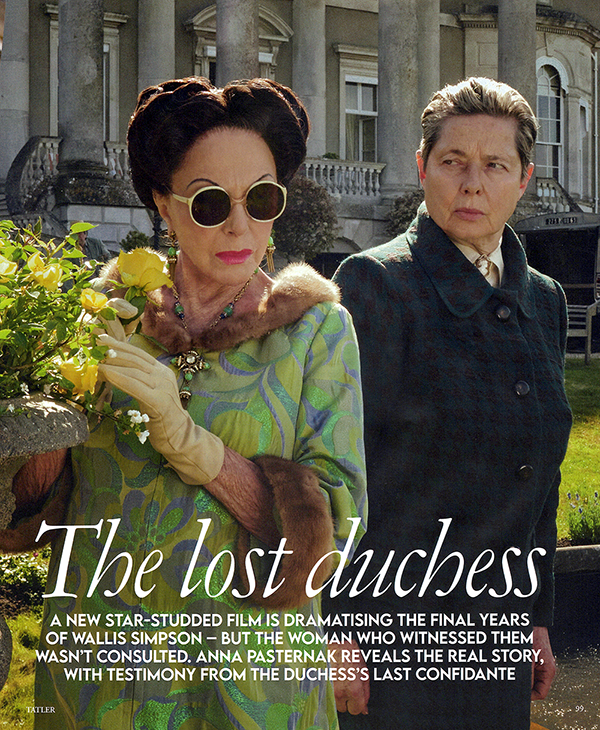
A new star-studded film is dramatising the final years of Wallis Simpson – but the woman who witnessed them wasn’t consulted. Anna Pasternak reveals the real story, with testimony from the Duchess’s last confidante
When I heard that Joan Collins is to portray the Duchess of Windsor in My Duchess, a film about the tragic, twisted end to Wallis Simpson’s life, I had mixed feelings. While I actively champion anything that celebrates Wallis, a woman so beguiling that King Edward VIII renounced his throne and the entire British Empire to marry her in 1936, the thought of Collins as Simpson unsettles me. Dame Joan Collins is a beloved National Treasure and doughty survivor. Poor Wallis was never the former – even though Noel Coward famously said that “a statue should be erected to Mrs Simpson in every town in England for the blessing she had bestowed upon the country” – (referring to the removal of Edward VIII from the throne), but she was certainly the latter. She had to surmount becoming the most hated woman in the world after the abdication, the 90 year anniversary of which falls this December. The false narrative about her – that she was a scheming, sexually depraved bitch who strove to be Queen– sadly often holds sway.
So I salute Collins, who said in support of Simpson: “I’m fascinated by women who everybody says are nasty people. And when you strip it all off, you find out they are not really.” A sentiment that I have been hollering since I wrote The American Duchess, The Real Wallis Simpson eight years ago.
However, images released from the set of the film written by Louise Fennell, Emerald Fennell’s mother; a film which has been kept tightly under wraps and described as “part royal biopic, part psycho buddy horror, with a touch of erotic thriller and a whole heap of camp” concern me. As much as I admire Collins as a woman, I worry that she possesses the elan to convey the Duchess of Windsor’s style, complexity, grace or refinement.
Johanna Schutz, who was the private secretary to the Duke and Duchess of Windsor for eight years from 1967 is similarly sceptical. Strangely, Schutz was not asked to consult on the film, which seems an error when Schutz is the last woman alive who knew the Duke and Duchess of Windsor intimately. There is a secretary in the film called Marianne, loosely based on Johanna’s character. Whatever the reviews of the film, Schutz is delighted if the truth about the Duchess’s decency comes to light.
Johanna Schutz practically lived in the Windsor’s Parisian mansion in the Bois de Boulogne in the seventies, (when she was in her late twenties) becoming the daughter that the royal couple never had. Drawn in particular to the Duchess, who was witty and kind, Johanna’s job was as gatekeeper in charge of their staff and diary. Once regularly besieged by European Royals desperate for an invitation to one of Wallis’s legendary dinners where guests included Richard Burton, Elizabeth Taylor, Marlene Dietrich, Cecil Beaton and The Emperor and Empress of Japan, the glory days for both Wallis and Johanna came to an abrupt end when the Duke died in 1972.
Soon afterwards, from being the Duchess’s confidante and companion, who travelled with Wallis regularly to America when she was first widowed, Johanna found herself impotent to help once the royal couple’s French lawyer, Maître Suzanne Blum, seized ultimate power.
The Duchess of Windsor became a prisoner to her lawyer, whom Schutz describes as “evil.” It is the twisted domination of Simpson by Blum that My Duchess depicts, with Isabella Rossellini playing the satanic lawyer.
Johanna, whose enmity towards Blum is understandably vociferous having witnessed her reign of terror, says that Rossellini’s hair is “completely wrong” in the film. Rossellini portrays Blum as severe brunette when the lawyer’s hair in those days was “white, short and messy.” (Bizarrely, Blum was only two years younger than Wallis but unlike the Duchess, was in punishingly rude health.) Blum, who in her heyday had acted for Charlie Chaplin, Walt Disney and Rita Hayworth, developed a macabre obsession with Wallis, carefully dismissing the duchess’s loyal retainers one by one.
Johanna promised the Duke of Windsor that she would protect the duchess after his death, an undertaking she did not take lightly. Matters took a sinister turn when Johanna returned from a family Christmas ski trip in late December 1972, six months after the Duke died. The Duchess, who had pretty much given up eating, (but did not drink much as is often erroneously depicted) was in bed, frail, and in severe pain. Johanna discovered that she had fallen and broken her hip, which John Utter – a retired American diplomat who had been the Duke’s private secretary – and Maître Blum, then an increasingly regular visitor to the mansion, conveniently ignored. Johanna insisted that this poor woman, wincing in agony, was operated on. The Duchess was given too much anaesthetic, prolonging her recovery for two months in hospital in Paris.
While Wallis was disorientated, in January 1973, Blum took advantage and as an executor of the Duke’s will, persuaded the Duchess to terminate the services of the Duke’s long-standing lawyer, Sir Godfrey Morley of Allen & Overy. Vulnerable and fearing for her future, Wallis capitulated as Maître Blum began a financial, emotional and persecutory campaign against her. Blum wrote a new will which bequeathed the Duke and Duchess’s estate to France, not Britain, which the Duke and Duchess had wanted. Blum warned the Duchess that if she did not sign, the French Government would make her pay back rent on her home where she and the Duke had lived tax free for decades, threatening the Duchess who had a lifelong fear of penury with the alarming prospect of huge tax bills.
Johanna explained to me that Blum “was a big friend of Jacques Chirac, who was then the mayor of Paris. And that’s how they got her because Blum said to her ‘if you do not do this, they will throw you out of your house because your home belongs to the City of Paris.’ They threatened her and the poor thing was terrified. I kept telling her that there was enough money but I couldn’t calm her.”
Johanna is convinced that Wallis’s signature on a letter written on January 19th 1973, of which I have seen a copy from the Duchess’s archives, reads: “Dear Suzanne, This is to confirm to you that I appoint you as my sole legal representative and as my sole advisor” is a fake.
Machiavellian Blum fuelled the Duchess’s worst fears that others were taking advantage of her. Johanna tried to get word to the late Queen Elizabeth II that the Duchess was effectively a hostage in her mansion, as Blum was banning friends from visiting. The Queen sent her lawyers to investigate but by then Blum had wrangled power of attorney over the Duchess’s Estate, rendering the lawyers powerless to intervene.
In her archival papers, the Duchess has a letter written on 22nd January 1973 from Sir Godfrey Morley, of Allen & Overy. He had looked after the Duke’s legal affairs for over twenty years and wrote to the Duchess mentioning three charities that might be candidates for legacies in her will. Without any previous indication of her plans, the Duchess replied (almost certainly by Blum’s hand) on 26th January sacking her husband’s faithful and decent British lawyer: “It will be unnecessary for Maître Rosselli (his French counterpart) to prepare a new will or to call me, as I have already taken the necessary steps with regard to my will.
“I feel therefore constrained to inform you that I revoke any and all power or charges heretofore given to you and Maître Rosselli. With gratitude for all the services which you have rendered the Duke and myself in the past, and with best wishes, Yours Sincerely, Wallis, Duchess of Windsor.”
This curt, dismissive style is authentic to Wallis, warm and loyal to her core. Sir Godfrey was astonished, reminding the Duchess’s sly Swiss banker, Maurice Amiguet, who became aligned with Maître Blum, of “how insistent the Duke was that I should be involved.” While Sir Godfrey’s reaction was to explain to his firm that “the Duchess of Windsor has gone a bit funny lately and has discontinued consulting me and is now advised solely by her French lawyer,” he harboured serious doubts as to how the decision to remove him had been effected.
What was devastating for Johanna, witness to the cruelty and the captivity unfolding, was that she and the Duchess had planned their escape. After Wallis had recovered from her hip operation, they made secret plans for the Duchess to move back to America but a perforated ulcer rendered the already ailing Duchess too ill to travel. This sealed her fate.
Johanna says that during this time, the Duchess expressed her hatred of Blum to her face, repeatedly telling the lawyer “I hate you.” This explains why Blum prevented her friends from coming to visit “in case she repeated to her friends how much she loathed Blum.”
The Irish society hostess Aileen Plunket, described Wallis as becoming “Blumed.” When she tried to visit Wallis, Blum turned her away, saying that she might endanger the Duchess’s life. This made the elegant octogenarian incandescent: “If the Duchess was too ill to want to talk, I only wanted to peek my head through her bedroom door. I wanted to wave to her…I wanted to blow her a kiss and maybe put some flowers by her bed….I only wanted Wallis to know that I hadn’t forgotten her.”
Paranoid, frightened and alone, the Duchess was forced to secretly call Johanna (before Blum removed the phone by her bed) to ask Johanna to meet her in her bathroom, where like a scene from a crime caper, they were forced to whisper against the noise of running taps. Wallis told Johanna that Blum was poisoning her. Fearful of Johanna’s grasp of the situation, Blum then tried to change Johanna’s contract, telling her that she would only be allowed a five-minute window each week in which to sit with the Duchess.
“It was terrible and it was just awful for me,” Johanna recalls. “I suffered as much during that time as the Duchess did. I tried everything but I could not do anything. It was Blum, and the doctors, Doctor Thin and Doctor Antonucci, who were against me.” Eventually, as the Duchess became less cogent, slipping towards dementia, Johanna, who refused to renew a contract that rendered Blum her boss, left.
On 25th March, 1976, Harley Street doctor, Robin Beare, wrote to Maître Blum after Lady Monckton visited him. Bridget Monckton, 11th Lady Ruthven of Freeland, was the second wife of Walter Monckton, a key advisor to King Edward VIII during the 1936 abdication crisis.
Beare told Blum: “I had a long talk with Lady Monckton yesterday evening and I explained to her how seriously ill the Duchess is, and, more particularly, your own dilemma with regard to Lady Monckton’s natural desire to visit her old friend, and the veto on visitors which has been imposed by Drs Thin and Antonucci.
“I have thought about this very carefully and I have come firmly to the conclusion that Lady Monckton should pay a visit to Her Royal Highness in the near future for the following reasons-.” Beare then details that Lady Monckton is the Duchess’s oldest and closest friend, regarded as family and it might be the last time she sees the Duchess. He concludes: “It is impossible to predict whether such a visit would be beneficial or detrimental to the Duchess’s health, and this can only be established by a ‘therapeutic trial.’ It might well do her a lot of good, and I hope it proves to be so.
“Lady Monckton has, in fact, been invited to Paris on 8th April to stay with friends and will get in touch with you before or after her arrival.”
Unsurprisingly, Lady Monckton’s access was denied. Johanna wrote to all the Duchess’s friends, explaining the situation and why she was forced to leave. Hand-written condolences came from all the Duchesses friends, including Estee Lauder, who wrote from her villa in Cannes, thanking Johanna for “all your kindness” to the Duchess, “and all your courtesies extended to us – we do appreciate it so very much.”
An American friend of the Windsor’s, William Hickman, wrote to Johanna from his home in Tennessee on June 14th 1978. “Dearest Johanna, With sadness I respond to your letter. Indeed, you and the pugs were the best friends that the Duchess had in the year after the Duke passed away. I am grieved that you must leave the Duchess in her final days – and that Her Highness must die such a cold death without a friend by her side such as you. You have a fond memory of past years with the Duke and Duchess that is golden and a consolation in the tragic times as now. Love always, Bill.”
It is heartbreaking that the Duchess of Windsor, once one of the most famous women in the world – an icon of style and champion of couture – died alone in threadbare sheets in 1986, aged 89. Johanna Schutz believes that Blum detested the British, which is why she persuaded the Duchess that the proceeds of the sale of all jewellery should go to the French Pasteur institute, as opposed to them being returned to the Royal Family in Britain, which was Wallis’s intention. (They sold in Geneva in a landmark sale in 1987 for $50 million.)
Sir Reginald Hibbert, British Ambassador to France from 1979 to 1982, wrote in 1988, “Maître Blum was a doughty crusader. It was surprising that an intelligent woman should have chosen so poor a cause.” Indeed. The Duchess of Windsor did not deserve this. It remains to be seen whether the film My Duchess is worthy of her, either.